Squash & Stretch

The act of expanding and contracting a moving object, any moving object, when starting or between poses. These help fill in empty spaces in the shot and help convey motion. This is useful for conveying force.

Anticipation

Natural motion needs a windup before a payoff. Anticipation is the action animated before the main action. If a character needs to swing a sword, for instance, they first have to hoist it in front or to the side. The action taken to initiate the main action is the anticipation and is most useful to telegraph to the audience what's physically happening and when.
Staging

Staging is the process of highlighting the importance of an action by means of centering, emphasizing, or directing the audience's line of sight. Most theatrical direction and coreography involved in narrative animation takes this into account and without it, the subliminal direction of a scene can be lost. This is useful for story beats.
Follow Through
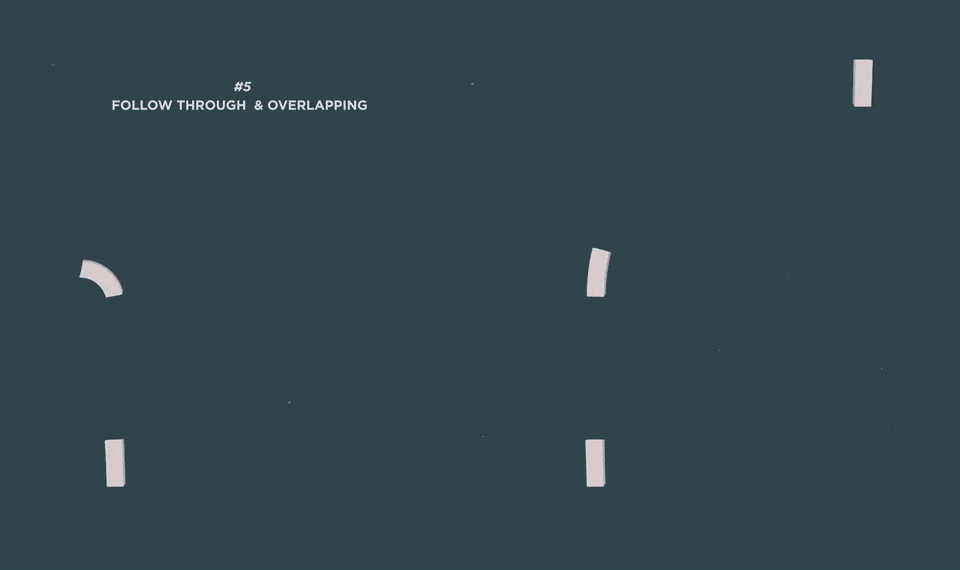
Nothing ever truly comes to a dead stop in physics. No matter how small, everything has to account for force. This is the manual accounting for that force, adjusting for a physical object coming to a halt. For an observer to really feel the impact, the animator needs to communicate the stopping power of the holder and the continuous motion of the held. This is mostly used for communicating force between objects, but is very applicable to simple armatures, like hands and feet stopping.
Slow In & Slow Out

Also known as easing, natural motions start at zero and gradually increase their speed until they hit the apex of their motion, thereafter slowing down until the next pose is reached. This goes into follow through and benefits natural beings more than artificial ones. As these principles are tools, discarding them is also an option, such as making movement for robots stiff and non-organic.
Arc

The bread and butter of eye candy. The arc is a drawn trajectory between one pose and another, communicating force, physics, and natural motion all in one. In a parabolic arc, such as an arm throwing a ball, using an arc can convey the weight of the ball, how far it will travel, and where it will land. Arcs are essential to in-between frames and are the reason computer animation always needs touching up. Without arcs, the movement can lack a sense of physical interaction with the world and can take an observer out of a scene. Lack of arcs can make something feel robotic, which can be intentional. Arcs are useful for just about everything natural.
Secondary Action

A character's offhand action, not intended to be highlighted but rather to fill in a blank scene. In some cases, characters are seen amid mundane tasks or natural states with no real reason for action, but static motion can be off-putting in animated works, and there are few members of any given audience who want to see still frames litter a piece. Secondary action gives characters a chance to characterize themselves or expose a facet of themselves to the audience, whether in foreshadowing or exposition. This comes in handy for dialogue scenes.
Timing

The speed that comes into play with the twelve principles. Timing a shot can change its mood, while changing the work load of the animators. Faster timing can let animators get away with fewer frames while slower timing can be more demanding with the amount of frames that need to be accounted for. Sometimes slow timing can mix with fast timing to create anticipation, as well as slow ins and outs. This is useful to know beforehand when staging or blocking a scene.
Exaggeration

From a distance, actions can be hard to understand. Exaggerating motion gives the audience clear indication of what's happening at a glance, and can lead one principle into the next. This trick is super useful in chaining principles together in one continuous flow.
Solid Drawing

The art of giving shapes dimension. Solid drawing is giving the illusion of 3D in a 2D space, and can be worked in reverse in 3D animation to give motion a more natural look. Perspective makes up staging and knowing what space an animator has to work in is important to their workflow. Things like when they need to know how far a ball can be thrown, or how far a character may need to travel, are important in scene composition. This practice is good in 2D animation to convey depth and is replicated in 3D using perspective tricks.
Appeal

What's a good plot without a good character? All these principles apply in giving every moving thing, living or nonliving, a soul. Animation is a transfer of imagnination from the sentient to the inanimate. Appeal is the act of giving moving things their own arcs, their own timing, a measure of how much they exaggerate, and a unique secondary action. Appeal is not useful or helpful, it's necessary. Without appeal, there is no character or reason to apply these principles. For the body to move, it must first have a soul. It's hard to quantify, but it does come to an artist naturally over time. This principle is why animation is an ever-expanding art. Before someone makes the next big animated blockbuster, they think to themselves, "What is the appeal?" This is step one, and even if it can only appeal to them, it will still have an audience.